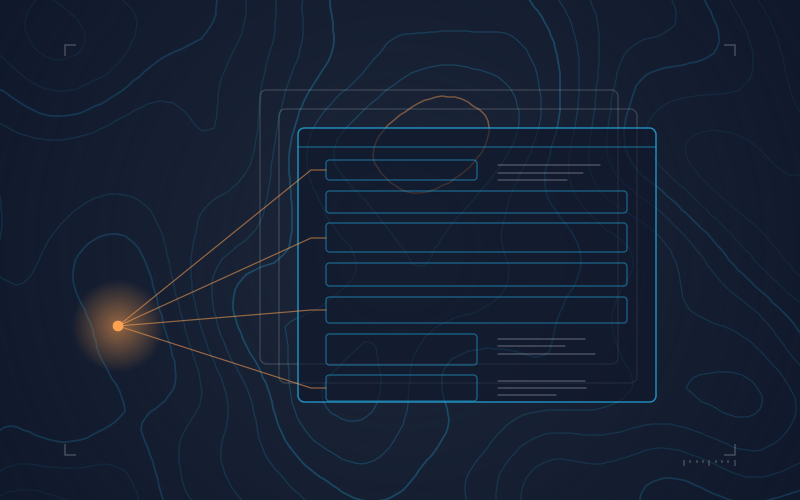
The published cases are very different: a Colombian freight operator and a United States last-mile delivery operator.
What these companies face
Logistics companies live between platforms. The freight operator in the first case works on the platform of a third party that settles its earnings, so keeping each waybill’s accounts correct per customer is the business. Its operation ran on a web application more than twenty years old, with hundreds of thousands of waybills in one database and a twice-monthly close built in a macro-driven spreadsheet. Every day someone retyped data that already existed on that platform.
The last-mile operator faced the same fragmentation at a smaller scale. Each day it built the dispatch sheet by hand, driver by driver and route by route, from a marketplace portal, a shift scheduler and a fleet system that did not talk to each other.
What KINTO builds for them
For the freight operator, KINTO rescued the old system, then built an agentic ERP with automatic ingestion, full history, a financial engine, a labeling tool for sticker printers and a public site. The guiding principle was autonomous by default, human by exception. Hundreds of thousands of historical waybills, more than a decade of them, were loaded, and the case measured freight savings of about 29 to 50%, depending on tonnage, from a semi-bulk load rule.
For the last-mile operator, KINTO co-developed a dispatch cockpit that reconciles the platforms and proposes assignments, with compliance treated as design: no evasion techniques, no acting on the marketplace’s behalf and minimal driver data.
What the cases show, and what they do not
The freight case has the stronger evidence: six months matched to the cent on all shared waybills. The last-mile case is a pilot. About ten competitors were analyzed and none integrated the shift scheduler or the fleet, but the pilot lost access to the operator’s platforms and monetization remains undecided.
How the work started in each case
In both cases the first deliverable was understanding, not code. For the freight operator, KINTO audited the legacy system, turned recorded meetings into a prioritized list verified against the code, documented that platform’s real limits and validated waybill by waybill rather than by totals. The business signal was already visible in the data: high-value customers had stopped shipping without anyone noticing.
For the last-mile operator, KINTO synthesized weeks of voice notes and messages between the partners, transcribed locally, mapped each platform section by section with facts verified live and ran a competitive and compliance analysis. Long meetings became a task board. The result was a product definition the operator could test before anything was built.
Where to go next
The ERP method is described under agentic ERP. The old-system rescue sits under migrations and rescue.